This article examines how cultural heritage can be meaningfully integrated into contemporary design through reinterpretation rather than direct replication. It argues that everyday objects such as furniture, textiles, and accessories can serve as subtle carriers of cultural identity when traditional motifs are translated into new visual languages instead of copied from historical sources. At its core, it presents SANGER’s approach to design as a way of evoking cultural emotion quietly and intuitively, embedding heritage into daily life through understated aesthetics rather than explicit symbolism.
Today, the question of preserving cultural heritage increasingly extends beyond museums, archives, and academic discourse. In a globalized world, culture is no longer static — it either adapts or dissolves. This is precisely why its native, almost imperceptible integration into everyday life becomes so important.
Modern individuals do not engage with culture through exhibitions on a daily basis. They live among objects — tables, textiles, tableware, accessories. And it is these objects that form the most organic medium for transmitting identity. Not through declaration, but through habit. Not through direct messaging, but through feeling.
Today, many designers, when working with cultural heritage, choose replication. Ornaments sourced from archives and encyclopedias are transferred onto products with little to no transformation. On one hand, this preserves visual continuity. On the other, it reduces culture to a decorative citation, stripped of evolution.
Such an approach creates the illusion of preservation, while in reality it freezes form, preventing it from developing. Yet culture, by its very nature, is not repetition — it is interpretation.
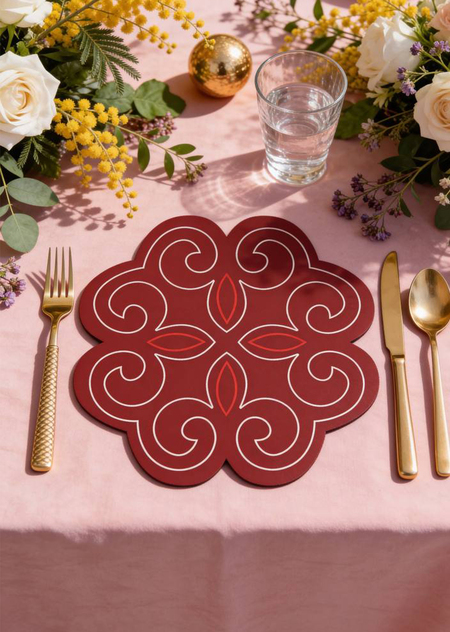
An alternative approach requires greater intellectual and aesthetic effort. It lies not in copying, but in reinterpretation. In creating new visual languages that retain the rhythms, principles, and emotional codes of traditional ornamentation, while expressing them through contemporary forms.
This is a delicate balance: to preserve recognizability without becoming literal.
It is here that everyday objects take on a special role. Home textiles, furniture, accessories — these are not merely functional items. They are mediators of experience. They shape the environment a person inhabits daily, often without conscious awareness.
When cultural motifs are embedded into such objects, they cease to exist as something separate. They become part of life — natural, effortless, and self-evident.
This is where the core idea of SANGER emerges: to evoke emotion subtly. Not through direct quotation, not through overt ethnic expression, but through an aesthetic that resonates on a sensory level. It is about working with associations, visual memory, and that which is difficult to articulate, yet easy to feel.
Such an approach creates a deeper connection to culture. It does not require prior knowledge, yet it sparks curiosity. It does not impose identity, but allows it to be experienced.
In the long term, this path may prove to be the most sustainable. Because culture, once embedded in everyday life, no longer needs to be preserved — it continues to live.
And perhaps the true challenge for contemporary design is not to display heritage, but to make it part of the present.